
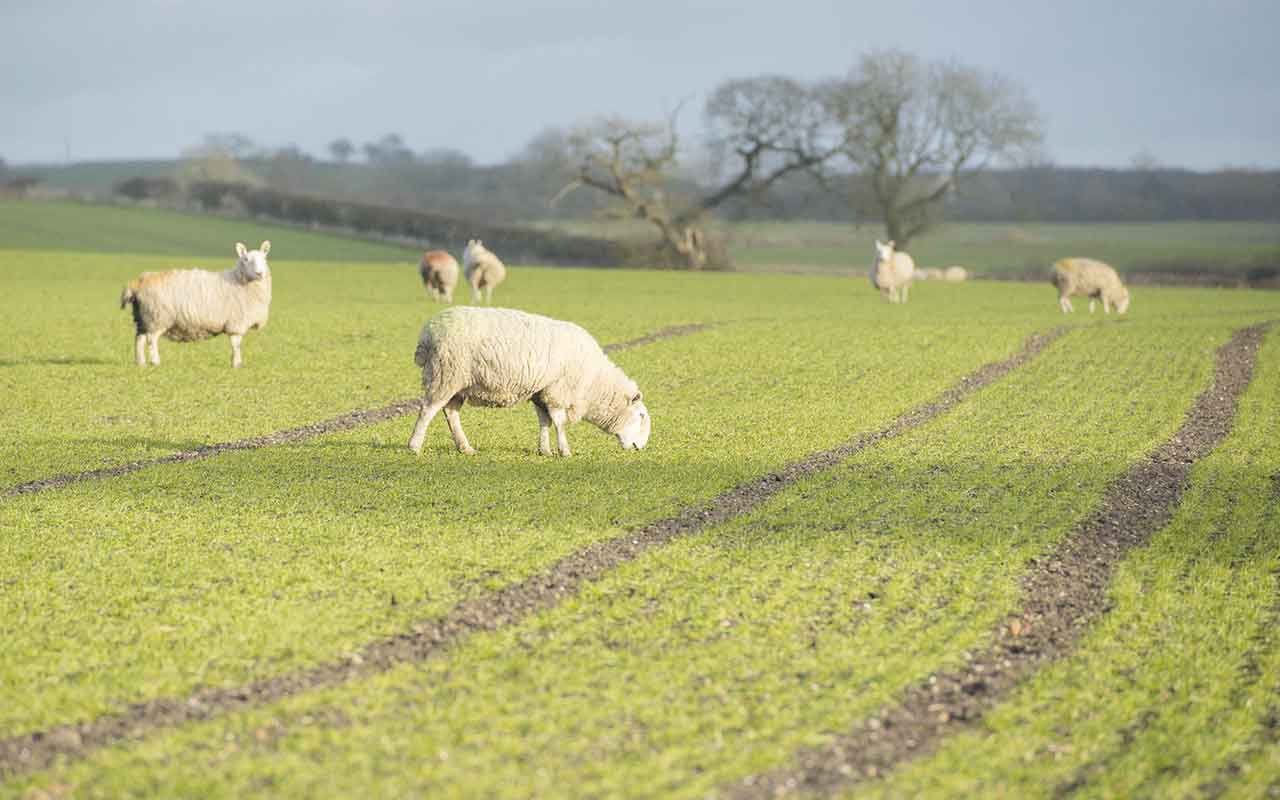
It was a spell in Australia that gave Anthony Ellis of Pensipple Farm, Cornwall, the idea of using sheep to graze off disease from cereal crops. If the ‘golden hoof’ strategy works down under, why not in the UK?
Of course, Cornwall is a little damper than the Barossa Valley, so he doesn’t need the supplementary feed, but he welcomes the nutrient cycling and weed and disease suppression it offers.
Now, a flock of 100 New Zealand Romney sheep graze the arable area regularly. They were introduced as he was keen to take a more sustainable approach to his soils, with the sheep grazing cover crops to cycle nutrients around the farm. He also ditched the plough in favour of strip-tillage, and this combination saw a drop in synthetic nitrogen applications.
He therefore decided to try out grazing cereals. A simple side-by-side trial proved successful, as Anthony noticed a significant reduction in septoria infection later in the season, with diseased leaves taken out.
A more scientific trial
He then teamed up with Farm Net Zero, where he worked with Dr Hannah Jones to set up a more scientific trial to ‘get some numbers’ to verify the result.
They split a field, allowing sheep to graze part of it, which in turn was overlaid with four other treatments, a biological nutrition approach against a ‘conventional’ fungicide programme and a nine-way wheat blend versus Graham.
Anthony points out that it is only one trial, so caution is needed with the result. However, the grazed plot with the conventional disease control programme and no plant growth regulator (PGR) delivered a £40/ha saving.
With a focus on a sustainable ecosystem, he also welcomes the reduction in chemicals hitting bare soil, with crops still low in biomass and low to the ground.
Green leaf area assessments throughout June revealed septoria had started to infect the flag leaf by 19 June, but the combination of grazing, the blend and the conventional fungicide treatment had reduced disease across the plant by an estimated 20%. A further assessment on 10 July revealed higher green leaf retention from the grazed plots.
Although the biological treatment didn’t offer the same level of protection, at a cost of £170.49 it did offer an input saving of £60.62/ha.
Anthony has continued with wheat blends this season. “My aim is to have half the area as a blend and half as a single variety. Again, it’s about finding the right balance of risk exposure.”
He admits the grazing strategy is an opportunistic one. He hopes to get to a situation where removing diseased leaves and more biologically active soils will allow him to apply fungicides at T2 and T3 only.
This will free up finances to invest in the most potent chemistry if needed. However, he appreciates this might not be possible every season.
“If the spring is wet, septoria will take hold regardless of what I do, and if it’s really wet, I might be limited in terms of whether sheep on the fields is the right choice. I might have to revert back to a four-spray programme, but the strategy might still allow some flexibility on product and rate.”
The sheep normally start nibbling away on the wheat around late January/early February, but they have to be off before growth stage 30. This year, he has had to move them around more frequently, as 400mm of rain in January had saturated soils.
“They weigh 90kg apiece – they can do some damage,” he adds. If it stays wet, he might have to put them back on the grass well before GS30.
With the gap to a circular system closing, a number of input savings are being realised.
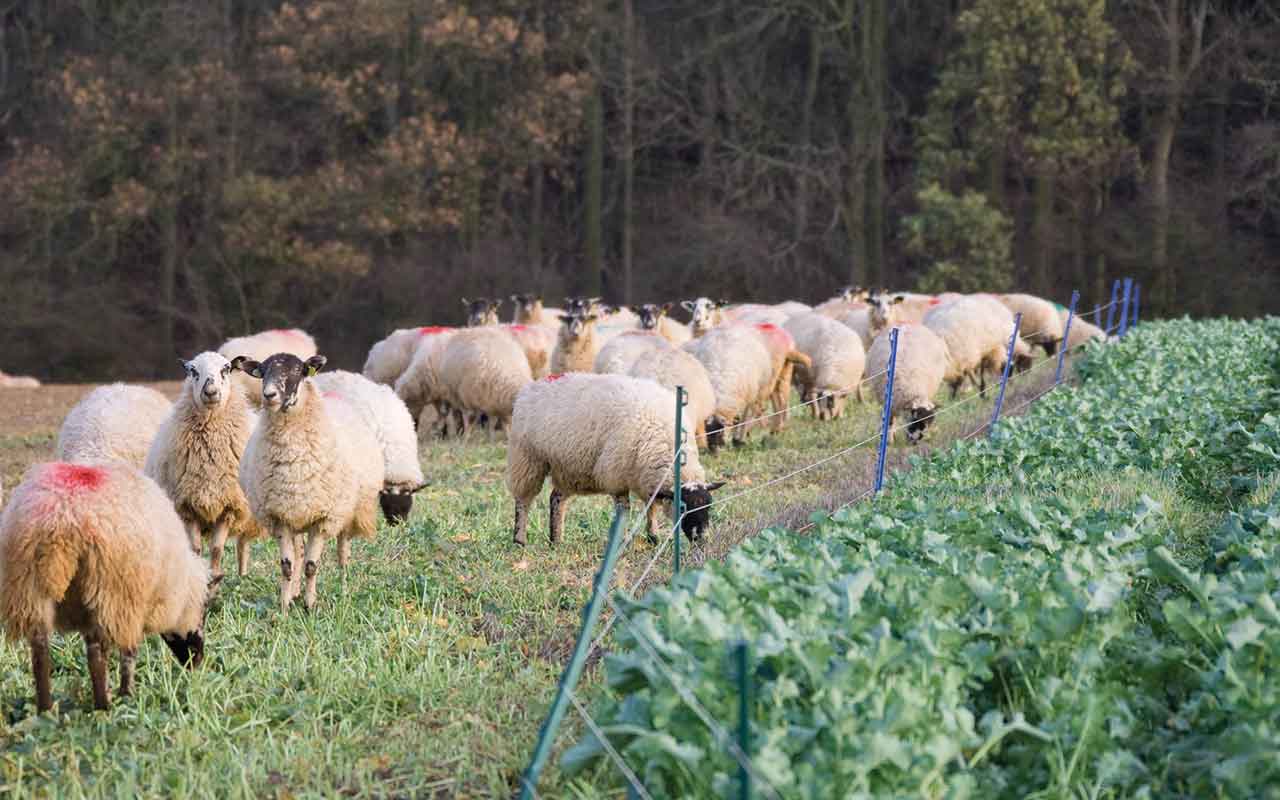
Better margins could outweigh the hassle of moving sheep around © Tim Scrivener
Other savings
Moving to a reduced-tillage system with cover cropping and a straw-for-dung deal has trimmed 25kg/ha off nitrogen fertiliser requirements, saving a further £35/ha on the inputs bill. It also gives the pasture a rest, strengthening roots and boosting weed control.
He estimates the sheep are taking off 250kg/ha of dry matter. With feed costing £100/t, combined with the reduced inputs, this means a saving of about £102/ha at 2023-24 values.
The downside is a possible delayed harvest, which might be troublesome for those with big areas. The other issue is the hassle of moving the sheep and putting up temporary fencing.
The trials work also helped him refine the crop nutrition strategy. A zinc, manganese and seaweed extract is followed with a combination of silicon, humic acid, boron and manganese, often applied around GS30 to get crops on an even keel out of winter. This is followed in the spring with fortnightly SAP testing, and nutrients are matched accordingly.
Further trials
This season, Anthony will trial magnesium sulphate at the T0 to aid early-season photosynthesis. He is also going to try melting his own urea and applying it as foliar nitrogen, although he has reservations over sprayer damage. “I’m trying to keep the plant as healthy as I can to prevent disease building up, plus reducing synthetic nitrogen use to boost margins further.”
As he looks to improve soil biology and resilience, he also wants to spread risk further. Not all the lambs go to a local abattoir; some are supplied locally to achieve a premium. The wool goes to a specialist yarn maker, Beyond Wool.
And with poor cereal prices, the system is working, as lamb prices are reasonably good. “If we ever get a season where prices are high for both, it will be a real bonus, but the approach is more about not being overly exposed in one area.”
Anthony is always looking to refine his approach. The break crop is a herbal ley, and a winter bird food mix as part of the Sustainable Farming Incentive has replaced low-margin spring barley.
“This comes to an end in 12 months and I’ll probably look to get a legume in. Bean performance can be variable, but nitrogen fixation will benefit the next crop, again helping to cut synthetic applications.”