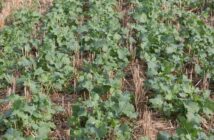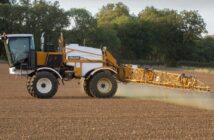

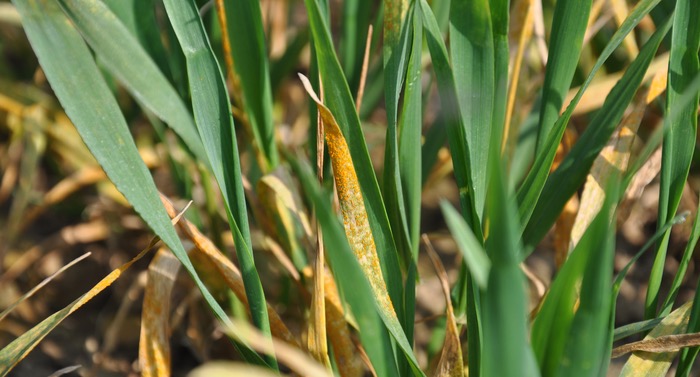
Good coverage underpins fungicide efficacy, but can be challenging in large biomass crops where sprays can struggle to penetrate down the canopy, says Hutchinsons agronomy innovation director, David Howard.
The spectre of yellow rust is a big unknown this year given the changes to YR15 resistance, potentially bringing rust to the fore in more crops, beyond the usual higher risk eastern areas. “Coverage is particularly relevant for rust control, which as a sporulating disease with a short lifecycle, can rapidly reinfect up the crop from any inoculum on lower leaves,” he notes.
This is unlike septoria, which is spread by rain splash, so risk can be reduced by maintaining a ‘buffer’ of clean leaves between the lower and upper canopy.
He suggests paying attention to nozzle choice, forward speed, boom height, and crucially, water volume. Some growers look to reduce water volume to save time during busy periods, but this should not compromise coverage.
Upping rates from 100 to 200 litres water/ha may be a step too far, but 150 litres/ha could be a good compromise in certain situations.
When it comes to product choices, he says isoflucypram is more of an all-rounder for rust and septoria, but septoria control can be bolstered by using it with other chemistry, such as prothioconazole or fenpicoxamid.
Alternatively, look to mixtures of fenpicoxamid with other rust-active chemistry to achieve balanced protection.
“Given their rust activity and longevity, strobilurins have a valuable role at T2, if not already applied earlier in the programme. Equally, milling wheat growers concerned about brown rust may want to reserve a strob for T3, however if pressure is high at T2, react to what is already there, rather than risk letting disease get established, he adds.
He recommends that in higher septoria situations, pydiflumetofen and fenpicoxamid are two of the strongest actives available.
“Folpet may be a useful addition in high septoria situations, and as a multisite, aids resistance management. Indeed, wherever possible, aim to bring different modes of action into the programme, as persisting with SDHI/azole mixes repeatedly will potentially cause challenges going forward.”