
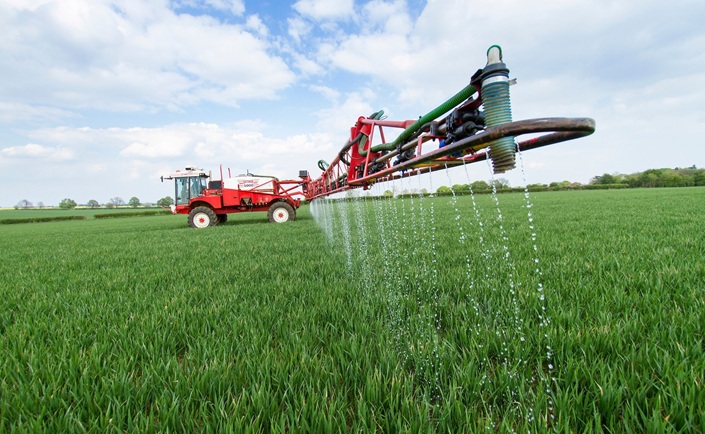
Despite rising fertiliser prices, late-season foliar nitrogen applications to help maintain milling wheat yields and ensure protein specifications are met could still produce a return on investment (ROI) of around 2:1 for growers, suggests Agrii.
It suggests that missing the £20/t premiums on offer for the best Group 1 milling wheats could cost growers dearly if concerns over fertiliser prices cause them to avoid late nitrogen top-ups, says the company’s national fertiliser manager Tom Land.
“Wheat will always prioritise growth over grain quality,” he explains. “So, if crops do not have sufficient nitrogen available to maintain both yield and protein as the season progresses, protein levels can fall rapidly.
“It’s important, therefore, to plan ahead and understand what residual soil nitrogen is available, how much has been applied and make sure there is sufficient available to support both yield and grain quality.”
If there is any doubt, he suggests carrying out a root protein prediction test to give the most accurate guide of what likely grain protein levels will be.
“A late-season tissue test is also an option, but the root protein prediction test has proved to be the most accurate. This can be taken in late May or early June around growth stage 73 but it’s important that no recent nitrogen applications have taken place.
“Growers can then weigh up the economics of a late foliar spray in mid-June. If you are growing a Group 2 variety without a contract, then it is probably not worth the investment.
“But for those who have a good Group 1 on a solid contract with top premiums on offer, then it almost certainly will be, but you will need to check the detail carefully.”
Agrii calculates that the combined cost of the root prediction test and fertiliser top-up could be in the region of £85/ha. However, if it results in an 8.0t/ha crop that hits the protein specification, that could result in a £160/ha gain – more if you manage to get a higher yield. So that’s approaching an ROI of £2 back for every £1 spent.
“Growers could further boost this by using a liquid carbon source to reduce stress in the crop and make sure every kg of nitrogen is used as effectively as possible.”
Latest AHDB recommendations suggest achieving 13% protein often requires nitrogen rates to exceed 280kg/ha with foliar urea after anthesis acting as an effective means to achieve this, Tom points out.
“It’s worth just checking with the buyer, however, as some millers still have restrictions on how late the nitrogen can be applied.
“If this is an issue, solid ammonium nitrate (AN) can be applied around growth stage 37 up until late May to achieve a similar effect.
“Either way, get calculations correct and a late-season top up of nitrogen can be a cost-effective means of achieving optimum yields of grain at the highest quality specification.”