
The move to nature as part of an integrated pest management (IPM) strategy might feel unnatural to some, but it is gathering pace.
Chemical giant BASF has just launched Apthena, a biological solution to enhance IPM practices. It isn’t a control agent – (E)-β-farnesene (EBF) is an insect attractant that helps draw aphid predators to their prey. Many predator insects rely on kairomones to detect prey, picking up their presence through the chemical signals they release.
Equally, some prey species use pheromones known as allomones to communicate the presence of predators to others. Some plants do the same, including wild potatoes, using EBF as a natural defence mechanism to deter being grazed.
They emit a chemical signal that makes them less favoured, known in the science world as anti-zoonotic resistance.
An ecological solution
EBF does a little of both. A naturally occurring compound, its chemical signal alerts predators to its presence, but it can also disperse aphids.
“Apthena is a tool as part of an IPM strategy,” says BASF business development manager Robert Storer. “A semiochemical, it is a behavioural changer, not a ‘cide’ – as in insecticide or fungicide.”
Such products are more often employed in high-value crop and Robert admits a behavioural change might be needed for mainstream arable enterprises. Viticulturists use semiochemicals to disrupt pest mating behaviour. Dispensers are hung in trees, emitting pheromones to change behaviour.
“For many, Apthina is a completely new concept in pest management. It’s an ecological solution, not a ‘nuclear option’ as an insecticide. Understandably, some will be cautious and question its cost benefit.
“But this is the direction of travel and as a business we have established BioHub to look at other opportunities and businesses we can partner with,” Robert says.
BASF sees its key benefit as attracting predators. “Kairomones are often of more value to the receiver than the emitter. Aphids emit a chemical alarm that is picked up by predator species.”
Not so new
Entomologists identified EBF as an alarm pheromone as far back as 1970. What has probably held back its use as a natural deterrent is that it is a volatile, unstable compound that disperses quickly.
To overcome this, BASF has developed a microplastic-free encapsulated formulation that controls its release over time.
Applied as a spray at 0.3-0.5 litre/ha, it helps suppress aphid populations by ‘drawing in’ the beneficials faster and more evenly than if left to natural colonisation.
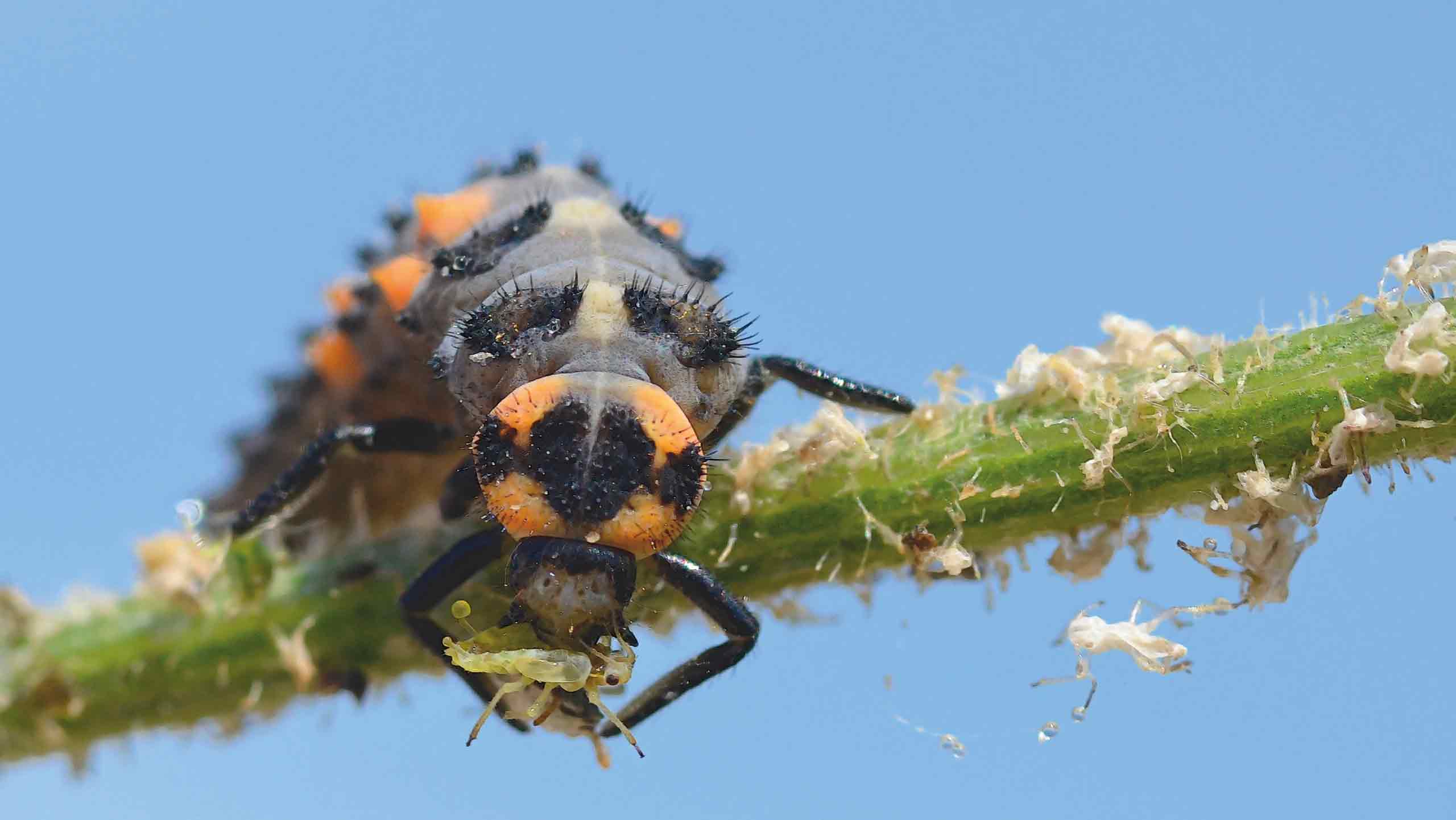
Although trials are limited, the proof of concept works. Tests using a Y-tube factometer have shown three-quarters of ladybirds were attracted to air laden with Apthena.
“It is all very well an insect detecting a chemical signal, but it’s whether it also produces a change of behaviour. This research shows it does.”
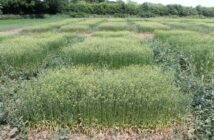
Field trials on peas and sugar beet are also promising. In peas, 10 days after an application of Apthena beneficial numbers were significantly higher than in untreated controls.
Similar work in sugar beet revealed lower aphid populations, put down to beneficial activity and probably some aphid dispersal.
Direct and indirect crop damage
Harper Adams professor Tom Pope says the extensive damage done by pests is down to direct and indirect factors.
“Stylets penetrate the phloem, ingesting sap and reducing nutrients in the plant. A further stylet injects saliva, which leads to deformities, necrosis and chlorosis.”
In addition, as aphids feed, the sugars they ingest are deposited as a sugar-rich waste known as honeydew. Not only does this reduce photosynthesis, but various species of fungi can grow on this and be transmitted from plant to plant.
Aphids also have an amazing ability to reproduce. “They give birth for much of the year and reach adulthood in one week.” Tom cited Dr Richard Harrington’s calculation that without natural limits, aphids could cover the Earth in a layer 149km deep in a single year.
IPM value
In his view, there is more than one reason why IPM strategies are so important.
Chemistry withdrawals and restrictions are reducing the number of actives that can be applied, meaning those being used are exposed to greater selection pressure.
He acknowledges that integrated strategies are not always easy to implement, deciding on the approach to take is complicated, and results can take time to be seen. But where growers get it right, there is a synergistic effect, which is something he likes about Apthena.
A range of predatory species have been shown to respond to EBF, including parasitic wasps, midges, ladybirds and hoverfly larvae.
“EBF is the basis of Apthena, which draws predators in and then encourages them to stay on the plant for longer and search more extensively for their prey.
“EBF can move beneficial populations where they are needed, like migrating predators from margin habitats such as a pollinator strip into the field, or even targeting hotspots within field areas, which could then be targeted with a follow-up biological control option.”
As a natural product, Apthena doesn’t need Chemicals Regulation Division approval, and synthetic insecticides can be employed in management strategies. However, both Robert and Tom warn of the potential harm to beneficial populations.