
Propyzamide has been reclassified. It’s no longer an HRAC Group 3 but the first Group 23, following a scientific review of microtubule active herbicides.
Corteva’s field technical manager, Hugh Guinan says this means it has a unique mode of action. “It has been classed as a microtubule interferer as opposed to a microtubule inhibitor. It behaves differently to other group 3s like pendimethalin. It uses a different binding site with a different resistance mechanism.
He is advising growers to sequence herbicides this season to boost grassweed control. Growers shouldn’t view Centurion Max (clethodim) and Astrokerb (propyzamide) as an ‘either-or situation’ but to employ both.
He says there aren’t many crops that offer the combination of good margins and good grassweed control. But good grassweed control means what he called hitting the ‘sweet spot’ when using propyzamide.
Balancing act
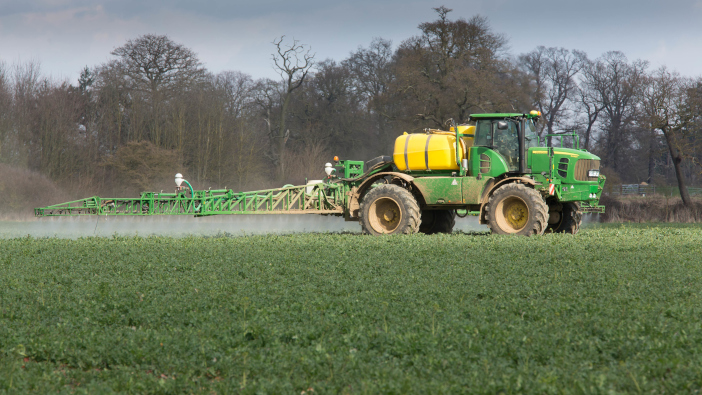
He points out application could be a balancing act of timing, application conditions and efficacy with the current weather volatility. “The absolutely perfect day may never come, so if the conditions are right, then go,” he suggests.
Those right conditions are typically around the end of October to early December when the soil temperature is at 30 cm is at 10°C and falling to optimise propyzamide’s persistency. “Too early and with it being warmer it will run out of steam, too late and then initial germinators will get big, especially with the lack of frosts these days, their roots then sitting below the propyzamide layer in the soil.”
When it comes to rates, 500g ai/ha isn’t sufficient in his view, more suited to controlling volunteers. He advised 750 ai/ha for lower grassweed populations and wild oats, rising to 850g ai/ha for larger plants, difficult blackgrass or bromes. He also stressed it can take 12 weeks for symptoms to show and there was no benefit in splitting or double dosing.
However, Tom advises growers to use Centrurion Max with a water conditioner. In UPL trials, combining it with X-Change has shown an 11% uplift in efficacy. Other tips for top performance include applying by 15th Oct or with OSR at the 6-leaf stage and targeting grassweed at the 3-leaf stage at a rate of 1.0 l/ha.
“Not all fops, dims and dens are the same,” says. UPL’s Tom Wheelhouse. Although clethodim is an ACCase Group 1A (dim) herbicide, of the three main target site resistance mutations, L1781, G2078 and R2088, clethodim is largely unaffected by the L1781 mutation.
It matters because when it comes to population frequency, L1781 is dominant in blackgrass (85%). In Italian ryegrass L1781 is still a significant share of the population but the G2078 mutation is more readily found. “It’s why clethodim is such a useful active within the rotation.”