

Have years of quick fixes meant some sustainable, longer-term solutions to improving soils have been overlooked? It is a possibility, suspects agronomist and diving enthusiast Richard Martin. He has been putting gypsum to good use for customers in his Essex and Hertfordshire area for several years, helping them repair poorer and damaged soils.
With much of his area being on the end of the Ice Age glacial sheet, there are some pretty poor soils in his region, with large tracts of Grade 3 soils and London clay. But even the better chalky boulder clay loams have improved.
Proof of gypsum’s properties is well documented – after the great flood of 1953, the UK government shipped great quantities of gypsum to the affected area to ‘wash out’ the sodium in soils. However, the mineral’s merits have, perhaps, been lost over time.
Growers have also been deterred by the lack of contractor availability, resulting in a heap of gypsum sitting around, delaying field work and attracting an extra cost to spread it.
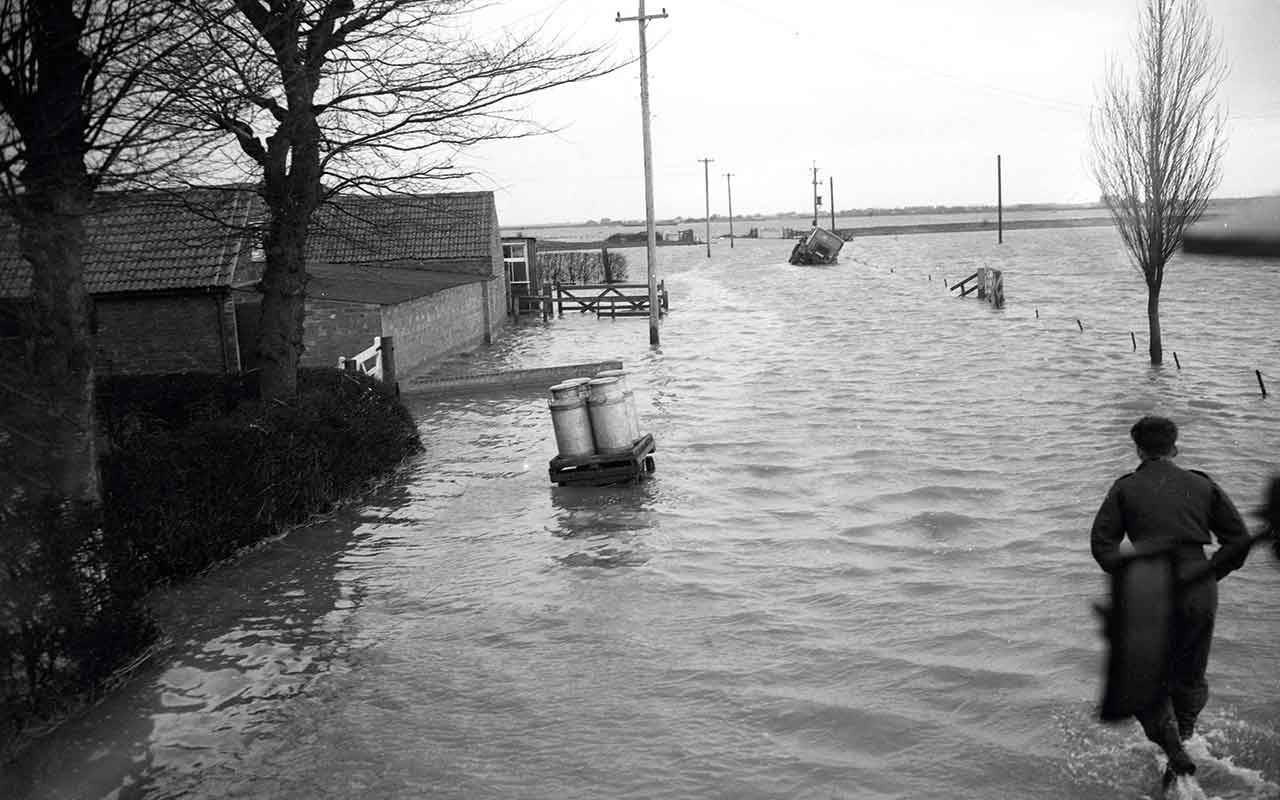
After the 1953 flood, the UK government shipped great quantities of gypsum to take sodium out of soils © Smith Archive/Alamy Stock Photo
A true solution
In its liquid form, gypsum can be applied through the farm sprayer, which is one reason why Richard is a big advocate. Growers can source this from the Plater Group, and as it is a true solution and not a suspension, the company claims it is 2,000 times more active than powdered gypsum.
Certainly, for one of those farms at the end of the glacial sheet, the results have been dramatic. Richard considered the ground at the farm in Stapleford, near Chipping Ongar, Essex, to be one of the most difficult Grade 3 soils on his patch, with two to four soil types across the field, and clay caps everywhere.
Yet after three to four years of applying liquid gypsum, they saw a substantial improvement. “During one of my visits, the farmer remarked how good his seedbeds were, noting ‘we don’t get clods any more’. It was a clear indicator of how soil structure had improved.”
The improvement in physical structure has made a significant difference to the chemistry and biology too. Improved aggregation ensures water and air passes through the soil more efficiently, boosting root development and supporting a plethora of soil organisms.
Gypsum can also alleviate symptoms of non-optimal soil pH, although Richard says it isn’t able to correct inappropriate pH levels. His attitude is that farmers are always taking something out of the soil, so they need to put something back in.
Now that the gypsum is working, the farm is administering a maintenance dose of 10 litres/ha, down from its original dose of 20 litres/ha. This is usually applied with the glyphosate ahead of drilling. They also include a healthy dose of molasses at 20 litres/ha.
In Richard’s view, soil and the biology it supports is the equivalent of a marine coral reef. “Any healthy reef is teeming with minute coral polyps, and this in turn support an array of small fish and invertebrates, which supports everything else. “It’s no different on terra firma. If the roots in a healthy, open soil are exuding sugars, it is feeding all the biology.”
Chemical properties
As gypsum is a calcium sulfate, it not only adds sulphur to soils, but calcium too, an essential element missing from many micronutrient mixes sprayed onto crops.
“Calcium aids soil flocculation. This improvement in soil structure not only promotes air and water movement, improves biology and increases root development, it also strengthens the membrane, which regulates the transportation of other nutrients and, therefore, boosts nutrient use efficiency,” Richard says.
The other benefit of liquid gypsum is that it penetrates into the soil profile, so it doesn’t necessarily have to be worked in.
How good gypsum is at keeping soils open and healthy can be seen from the Solvita C02-Burst soil test results. The test shows a health score based on the carbon dioxide released, and also gives a soil respiration figure.
Richard has compared results from a range of different cultivation and drilling systems. “The results show as long as you are feeding the soil, it doesn’t matter whether you are direct drilling or ploughing in sugar from cover crops. Both had a health score in the eighties. One field just had gypsum and molasses regularly applied, and that had a health score in the seventies.”
For those unsure about where to start, he advises an annual dose of 20 litres/ha, repeated for at least three years following a Solvita C02-Burst soil test. To get the best effect, gypsum may have to be applied a bit longer on heavier soils – equally, this can be shorter on lighter land.
“I’d advise sampling the best and worst fields first and comparing the two, then coming back two years later to see how they have changed.”
Mix compatibility
Richard also finds that liquid gypsum tank mixes work well. By applying the liquid gypsum before drilling, it can be mixed with glyphosate, liquid Avadex Factor and molasses, doing several jobs in one pass.
There are other ways of enhancing soil life. Lupins and soya beans are excellent nitrogen fixers, promote microbes such as mycorrhizal fungi and enhance nutrient recycling. The trouble is the end markets just won’t pay enough to make a stable profit. Sludge applications need a follow-up feed of green compost, and seaweed is always too costly for the amount he wants to put on. “At about £30/ha, gypsum is an inexpensive, sustainable, long-term improver,” he concludes.