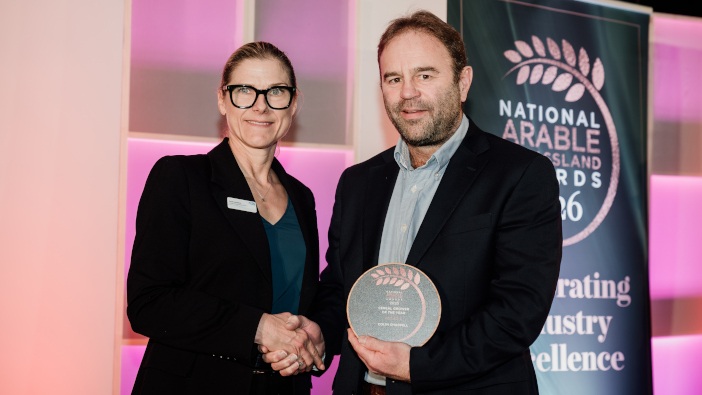
Following on from the highly successful Agronomy Exchange conference, the National Arable & Grassland Awards celebrated the talent and dedication of those who continue to excel in the industry.
Cereal Grower of the Year went to fourth generation farmer Colin Chappel
For the last 12 years, Crusoe has been the milling wheat of choice, averaging 10.5t/ha with less than 200kgCO2e/t footprint. The carbon negative enterprise now part of the ADAS Carbon Farm Demo network.
Crusoe might be too risky to grow in the future. Last season it averaged 11t/ha, but he had to use nearer 240kgsN/ha. He has switched part of his wheat area to Loxton for Warburtons.
It is that level of detail that impressed the judges. Colin does just about everything, including the crop walking, supported by two members of staff plus an apprentice.
Taking charge of matters for himself has seen a switch in management approach, the focus now on NUE (nitrogen use efficiency). Keeping roots in the ground over cultivation, with organic composts, has helped him reduce nitrogen use by a third in five years. Wrapping liquid UAN in carbon (using Nurture N and carbon N balancer) alone has boosted NUE efficiency by 10%, he believes.
The result is a considerable saving in input costs. The 24/25 season saw some fields receive just a single fungicide application to combat yellow rust.
A nutritional approach to crop health helped one crop of Bamford achieve 8.5t/ha using just 165kgN/ha with no PGR or insecticide and a £10/ha fungicide spend. Variable rate drilling also helped crop evenness and trim seed costs.
Weeds have been a problem in the past but Colin has amended his rotation to reduce seedbank return. He discarded the recommended maize growing protocol due to its heavy soil movement and use of mined nutrients, opting for roots instead.
Reducing soil-applied nitrogen has also helped Colin reduce herbicide inputs. The previously mentioned crop of Bamford had just one peri-emergence spray.
Considerable thought has been given to the rotation. Wide and diverse, it has helped improve soil structure. VESS scoring has shown topsoils at 1-2 and subsoils 3-4, Colin describes these as a “sponge” that absorbs vast amounts of water in the winter, which can then be released later into the spring when the inevitable drought kicks in.
The rotation includes winter barley for forage using BYDV tolerant, high biomass hybrid varieties that can be harvested early to ‘walk’ blackgrass off the farm, often sown with a vetch companion.
Premium markets are targeted with seed crops of winter and spring wheat, oats and winter barley. Typical growing costs of wheat in 2025 were £85-£110/t, all in, dependent on market requirements.
Lighter land supports miscanthus, which goes to the nearby power plant at Brigg. Maize, both forage and for AD, vining peas and OSR make up the rotation. This is sown with a three-way companion crop of buckwheat, berseem clover and fenugreek, the big canopy acting as a natural pigeon deterrent during winter.
Winter wheat follows, which in turn is followed by three years of spring cropping, including at least one year of a low-input crop such as spring oats, often grown after a cover crop of clover, Colin aiming to create a living mulch. The last crop of this cycle is often a legume (peas, beans or SFI grass and legume) allowing a return back to milling wheat, meaning nutrients are readily available in the soil, lessening the need for high nitrogen regimes.
Roots have also helped Colin restore degraded land, taking it back into production. A combination of cover, catch and companion crops and minimal disturbance ‘unlocking’ its potential. He notes cultivation is the quickest way of depleting soils of organic matter.
Not content to rest on his laurels, Colin is looking to the future. A young shepherdess now keeps her flock on 32ha of permanent pasture with the view to the grazing of cover crops being incorporated into the system to complement the lack of soil movement.
He has recently also upgraded the old drainage and 40-year-old grain stores, investing BPS payments to help him rein in spending in the future.
Regen ambassador takes Sustainable Champion
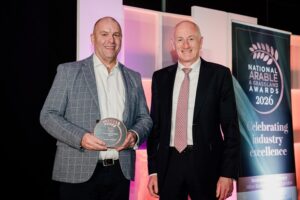
Russell McKenzie of D J Tebbit was named Sustainable Champion
Following his Nuffield Scholarship in 2014, Russell became a quick adopter of no-till practices.
Looking after soils had always been a key focus, but it was his ‘Success with No-till under any conditions’ scholarship that really opened his eyes to what was possible. He realised that he had been building soil organic matter levels and making his soils more resilient in difficult seasons for years.
Since he has become an ambassador for sustainable farming, speaking at the prestigious Rank Symposium on net zero and his approach to regenerative agriculture at Bureau Veritas in Paris.
Rightly, this impressed the judges, but more so did his approach in building a system that significantly benefits the environment and biodiversity.
With limited information sources, Russell took matters into his own hands and undertook numerous trials on his own farm, which is still ongoing today.
As well as evaluating variety performance under differing establishment methods, he has tested wheat blends, various input regimes (including nutrient strategies with soil conditioners and biostimulants) and cropping strategies.
By improving soils and keeping its biology fed, Russell has reduced wheat nitrogen application from 220 kgs/ha to 180 kgs/ha.
Straw is chopped to return residues, helping SOM levels rise to between 6.7- 7%. The diversity of cover and catch crops roots keep soil biology functioning, cover crops capturing nitrogen that may have otherwise been lost to the environment.
A good example was a crop of Siskin group 2 wheat, planted after spring beans that achieved 13% protein from an application of 185 kgs N/ha and a yield of 11.5 tonnes/ha. Through carrying out soil mineral nitrogen tests after cover crops, he has regularly found that 34-38 kgs/Nitrogen per ha is being captured that otherwise would have been lost.
When the opportunity arises, he also integrates sheep into the rotation to graze cover crops to start a natural recycling process, maintaining a circular nature to his cropping strategy
Part of his trials programme has allowed him to get more out of phosphate fertilisers. Over the past four years, he has been comparing the use of DAP to biologicals Luxor plus or minus Calfite.
The former is a mix of humic and fulvic acid with pidolic acid and L-PGA, which helps scavenge and deliver phosphorus during the spring growing season, the latter is a calcium phosphite product.
Russell is on P indices of minus two to one, and it has been well documented that a significant amount of phosphate in the form of TSP can be locked up after application and not be available to the plant. What he has discovered is that he can still produce high-yielding crops despite a soil index of one.
In his trials, he has regularly seen an uplift in winter wheat of 0.9-1.15 tonnes/ha from the Luxor/Calfite application at GS30. This can be above the responses from DAP, and where equal, it is at a fraction of the cost.
Of equal importance is a reduction in carbon footprint. Russell has partnered with the University of Nottingham’s soil department, comparing his methods to farms employing intensive cultivation practices. It revealed soil organic matter levels were 3% higher, a 20% improvement in water retention and crucially, capturing 30% more carbon with 34% less CO2 emissions from his soils.
That Russell is dedicated to farming in harmony with the environment is beyond doubt. Liquid fertilisers and glyphosate sprays are applied with a molasses-based carbon source to balance the carbon associated with such products.
He is also proud of it. For the last two seasons, he has been growing milling wheat for Wildfarmed, a distinctive, recognisable brand on the supermarket shelf.
The protocols include a restricted nitrogen level, reducing or omitting synthetic inputs, whilst also either growing a companion crop or planting in-field flower strips. All are features that enhance and benefit the environment, and help highlight the work farmers do to put sustainable food on the table.
Quality commitment helps secure crop grower category
Crop Grower of the Year was James Foskett of James Foskett Farms,
Covering more than 1,400ha, potatoes are the most important crop to the business, with onions, sugar beet, carrots, cereals and organic vegetables also playing a significant role in the turnover.
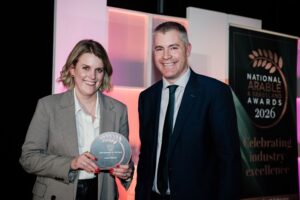
James Foskett was unable to attend the event. Jessica Church picked up the award on his behalf, seen here with Richard Thomas, Head of Landed Estates and Agriculture Strategy at Barclays. C: Colin Miller
The company moved into organic production after seeing an opportunity in the market, and since then organic carrot business has developed substantially, which James says reflects the business’s commitment to quality, sustainability and innovation. The crop is grown in the light, free-draining soils near the Suffolk coast, benefiting from a microclimate that protects from spring frosts and summer heat. Bunches are hand-picked and washed on-site before going straight into the chiller, extending the shelf life and maintaining the visual appeal, while also reducing waste.
Sustainability is at the heart of the enterprise. Solar panels are used to power the cold stores, and the organic labelling means that no chemicals can be used during the growing season, so flame weeders are utilised to keep the crop clean. Covers are used at establishment, ensuring that the carrots get away quickly.
It’s also added to the financial sustainability of the business, now making up around 35% of the total organic produce turnover. Initially starting on a small scale, with just a three-week harvesting window, the season now runs from early May through to November. In 2014, the farm produced 300,000 bunches. It now delivers over 1.5m bunches, working with major retailers and box schemes. Showing that customers do want fresh, naturally shaped and coloured produce, James notes that sales increased by 50% after 2020, when rainbow and purple varieties were added to the range.
The organic production also includes several varieties of potatoes, marketed to packers supplying UK supermarkets, as well as box schemes. Butternut squashes are established with a cover of biodegradable mulch to warm the soil and smother weeds; green beans are drilled with a fleece cover and hand-picked before chilling; beetroot is also hand-picked and bunched; and the company also supplies sweetcorn and radish, with the latter sown in small batches to keep a year-round supply.
It complements the conventional crops, where James still focuses on sustainable growing practices. Independent agronomy advice is sought for the potatoes, and precision systems are used for irrigation and chemical applications. The business is part of the AHDB Strategic Potato Farm Programme for the East of the UK, holding trials and open days.
Cereals comprise hard wheats, winter barley and rye, while maize is grown for a local digester – producing gas and electricity into the national grid – and sugar beet is grown on contract for British Sugar.
The combination of organic and conventional produce, all grown with a keen eye on soil type, optimised movement between fields, stores and end customers, and a clear understanding of the changing markets makes James Foskett a clear choice for Crop Grower of the Year, indicating best practice across multiple crop types and management strategies.
The National Arable and Grassland Awards are organised by Farm Contractor & Large Scale Farmer and Agronomist & Arable Farmer, in association with BASIS, the National Association of Agricultural Contractors, the Voluntary Initiative and sponsors AHDB, QLF, Barclays and Propel Finance.