
Chemical giant BASF has launched Apthena, a biological solution to enhance integrated pest management strategies.
Apthena isn’t a control agent. Indeed, (E)-β-farnesene (EBF) is an insect attractant that helps draw aphid predators to their prey. Many predator insects rely on kairomones to detect prey, picking up their presence through the chemical signals they release.
A naturally occurring compound, its chemical signal alerts predators to their presence but it can also disperse aphid populations. “Apthena is a tool as part of an IPM strategy,” said BASF business development manager Robert Storer. “A semiochemical, it is a behavioural changer not a ‘cide’ as in insecticide or fungicide.
Viticulturists use semiochemicals to disrupt pest mating behaviour. Dispensers hung in the trees, emitting pheromone to change behaviour.
“For many, Apthina is a completely new concept in pest management. It’s an ecological solution, not a synthetic such as an insecticide. Understandably, some will be cautious and question its cost benefit. But this is the direction of travel and as a business we have established BioHub to look at other opportunities and businesses we can partner with,” he noted.
BASF sees its key benefit as attracting predators. “Kairomones are often of more value to the receiver than the emitter. Aphids emit a chemical alarm which is picked up by predator species,” added Robert.
Trials have demonstrated its potential. In standardised Y-tube choice tests, ladybirds exhibited a significant preference for vessels emitting air with Apthena, opting to travel down the pheromone gradient far more frequently than controls.
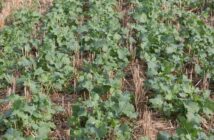
Field assessments confirm its effectiveness on-farm. In peas, Apthena increased the number of plants containing beneficial insects by 18%, and in sugar beet, the presence of aphids was significantly reduced from an average of 2% to 0.5%.
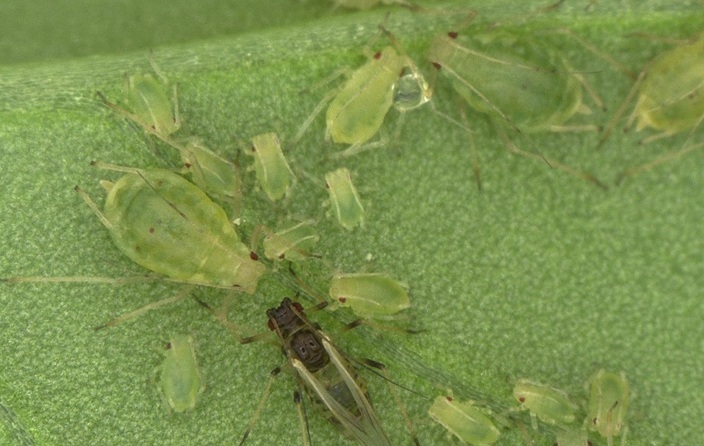
Aphids pose a massive threat to global crops, causing billions in damage annually through direct nutrient extraction and virus transmission,” warned Tom Pope, professor of applied entomology at Harper Adams University.
Demonstrating aphids’ phenomenal ability to reproduce, Tom cited Dr Richard Harrington’s calculation that without natural limits, aphids could cover the Earth in a layer 149 kilometres deep in a single year.
However, the number of insecticides growers can use is shrinking. With fewer products available, the selection pressure from remaining conventional products is rising, further increasing the risk of resistance. This is why Tom says IPM is essential.
“Apthena is an exciting new tool within the toolbox; it is an enabler and fits alongside other tactics that draw beneficial insects into crops.”