

Despite current farm economics, underinvestment in grassweed control this autumn could lead to issues in following seasons. The BASF briefing kicked off with data from The Anderson Centre’s Loam Farm, which made for rather sobering viewing.
After two challenging seasons, margins from production have been in the red. Without the income from environmental schemes and the Basic Payment Scheme, the farm would have lost money in the past two seasons.
The 2026-27 season doesn’t look that rosy, either, with the budget showing a production deficit. “Increasingly, farmers are having to rely on environmental schemes or diversification to remain profitable. Half of English farms have some form of diversification,” said Anderson’s senior agribusiness analyst, James Webster-Rust.
Despite the prospect of higher grain prices, the problem is that input costs have risen further. “The cost base is still in the post-Russia-Ukraine conflict phase. It is vital that every pound spent delivers on return on investment,” he added.
There is no guarantee that the post-Russia-Ukraine atmosphere will change in the short term either. The need to keep grassweeds in check is essential to help preserve farm margins, James added, and it is important growers get the most out of their input spend.
What has changed?
“Nothing has changed,” Adas weed expert John Cussans said. He reminded attendees of the importance of maintaining integrated management strategies, adding that many growers who drilled early last season ‘got away with it’. “We saw good conditions throughout the autumn for herbicide applications,” he added.
He said now isn’t the time to reverse-engineer grassweed control strategies on the basis of where farm economics are right now. The fundamentals of weed control haven’t changed. Later drilling and spring cropping are still a core part of an effective integrated control strategy, despite environmental factors sometimes coming into play.
To demonstrate this, he referred to a paper from the 2018 Crop Protection Southern Britain Conference on how conditions should dictate post-harvest cultivation strategies. This looked at three different plans. The conclusion was that there was little evidence of a link between the type of post-harvest cultivations and the weed density in the following crop.
Direct losses
Indeed, in dry conditions, leaving weed seeds on the surface isn’t a bad idea. “Blackgrass seeds are not adapted to these conditions. We haven’t appreciated the direct losses through the system. Post-harvest cultivation needs to be driven by the conditions.”
Turning to more recent data, John referred to work by University of Lincoln PhD student Jasper Kanomanyanga on predation and mortality seed loss. The work compared weed seed predation rates in conventional and no-till systems, with some surprising results.
Promising research on predation
University of Lincoln PhD student Jasper Kanomanyanga’s predation work is ongoing, but it has shown promising results, reflecting similar studies elsewhere.
Trials in 2023-24 and 2024-25 covering six fields (three conventional tillage and three no-tillage) looked at the predation by insects, birds and mammals. Predation was assessed using seed cards, secured to the ground to prevent damage or displacement by predators.
Over the two seasons, the predation of blackgrass, rye brome and wild oats varied, but the predation under the no-till system was consistently higher. This has been put down to better habitats increasing predator populations and species diversity; in one no-till trial it was as high as 79%.
This raises the question whether boosting habitats further through forestry and beetle banks could see predation taking a more prominent role in integrated strategies, especially if dry autumns become the norm.
“The predation rates in no-till systems are astonishing,” said John. “In some cases, close to 100% on a month-by-month basis for blackgrass, ryegrass and wild oats. In addition, if you leave the system undisturbed, there is also significant potential for predation by carabid beetles and small mammals.”
He understands the risk and reward growers face when it comes to winter wheat drilling, but stressed that the upside of delaying drilling is unchanged when it comes to weed management strategies.
Data from 2010 to 2026 revealed a two-thirds reduction in blackgrass seedlings in untreated plots where drilling was delayed by a month; the outcome improves for every week growers delay drilling through October and into November.
It can also improve the efficacy of pre-emergence herbicides, especially if the run of dry autumns continues. Data from the same trials with combinations of flufenacet, pendimethalin and diflufenican shows a 20% increase in herbicide performance. Research from Germany has also revealed a reduction in the need for a post-emergence top-up.
Having to work harder
But John admitted growers are having to work harder to keep grassweeds in check. He said it doesn’t mean anything has changed, but declining contact graminicide efficacy is putting the emphasis on pre-emergence strategies to mitigate the onset of resistance, bring in selectivity and lower interaction risks.
He suggested that even where germination patterns change and are delayed in response to a seasonal effect, it is always the plants that emerge within the crop that produce a higher seed return. “Later-germinating blackgrass isn’t the target; the priority has to be to target the seedlings that germinate early on and can produce the most seeds if not controlled.”
“Grassweed management will always come with a cost,” said BASF business development manager Stuart Kevis. Invariably, that is the cost of control, but also the yield loss from those weeds that survive.
To find out the balance of the two, BASF has developed a model, based on the aggregated results of over 750 company and independent trials. It uses a wheat yield of 9t/ha, grain price of £170/t and a base blackgrass population of 50 plants/sq m.
Stuart said the model is a guide to the likely outcome as growers weigh up their investment against the desired level of control, although he pointed out that growers can spend more and achieve less control, and vice versa.
But grassweed control cannot be viewed in isolation; seed return means a longer view is needed. Stuart said this is why investment in the right products at the right time is so important.
Model data
To illustrate his point, he presented data from the model looking at two seasons combined. Starting with a population of 5 plants/sq m, the model calculates the cost of the programme, level of control and subsequent yield loss plus seed return.
Consecutive autumn programmes of flufenacet + diflufenican + aclonifen, followed by a post-em of bixlozone + beflubutamid + pendimethalin, gave 89% control at a cumulative cost of £264.08/ha, but the seed return was 1,419/sq m.
A programme of Avadex XL, followed by flufenacet + diflufenican + acolinfen and then flufenacet + diflufenican, did better, costing £214.72/ha to achieve 93% control, with the seed return down to 651/sq m.
Cinmethylin + pendimethalin + diflufenican, followed by flufenacet + diflufenican, also achieved 93% control and the same seed return, but at a lower combined cost of £185.60/ha.
Modelling pre-emergence treatments only, it showed that even the strongest options were leaving seeds behind. A combination of cinmethylin + pendimethalin + diflufenican achieved 86% control, but the seed return was still over 2,000/sq m.
“None of these base pre-emergence programmes is providing effective blackgrass control. It is why growers have to invest in programmes that offer high percentage control,” Stuart said.
Ryegrass results
With ryegrass, this was even more apparent. A programme of cinmethylin + pendimethalin + diflufenican, followed by bixlozone + beflubutamid and prosulfocarb, delivered just 1% greater control than Avadex XL followed by bixlozone + beflubutamid + acolinfen, followed by pendimethalin + prosulfocarb, but the model predicted a cost benefit of more than £90/ha and a reduced seed return.
“Every percentage point counts,” Stuart said. “Growers must aim for 90% control; ideally higher.” In his view, Luxinum is critical to achieving more than 90% ryegrass control. BASF trial data shows Luxinum + Stomp Aqua (pendimethalin) + diflufenican delivered significantly higher control than a combination of flufenacet + diflufenican + aclonifen.
“Uptake is via the seed and root, and Luxinum with Stomp Aqua is the most effective start to a herbicide programme. We saw in our trials last year, during a dry autumn where wheat was drilled early, that the Luxinum with Stomp Aqua base still provided the best levels of blackgrass control, and topping up with Avadex improved this further,” he said.
Consider adjuvants to offset climate risk
As the climate changes, it will likely compromise pre-emergence herbicide efficacy. Pre-emergence herbicides vary widely in their persistence. This is commonly expressed as the DT50 value, the time taken for an active ingredient’s concentration in soil to decline by 50%.
Familiar actives such as diflufenican are among the more persistent cereal herbicides, with reported DT50 values often exceeding 100 days and, under some conditions, approaching 300 days. Others persist for much shorter periods – cinmethylin (Luxinum), for example, typically has a DT50 of 15-40 days.
Soil temperature, moisture, organic matter and, importantly, microbial activity all influence how long an active remains available in the soil. Higher microbial activity can accelerate degradation, reducing persistence as soil micro-organisms break down the active ingredient.
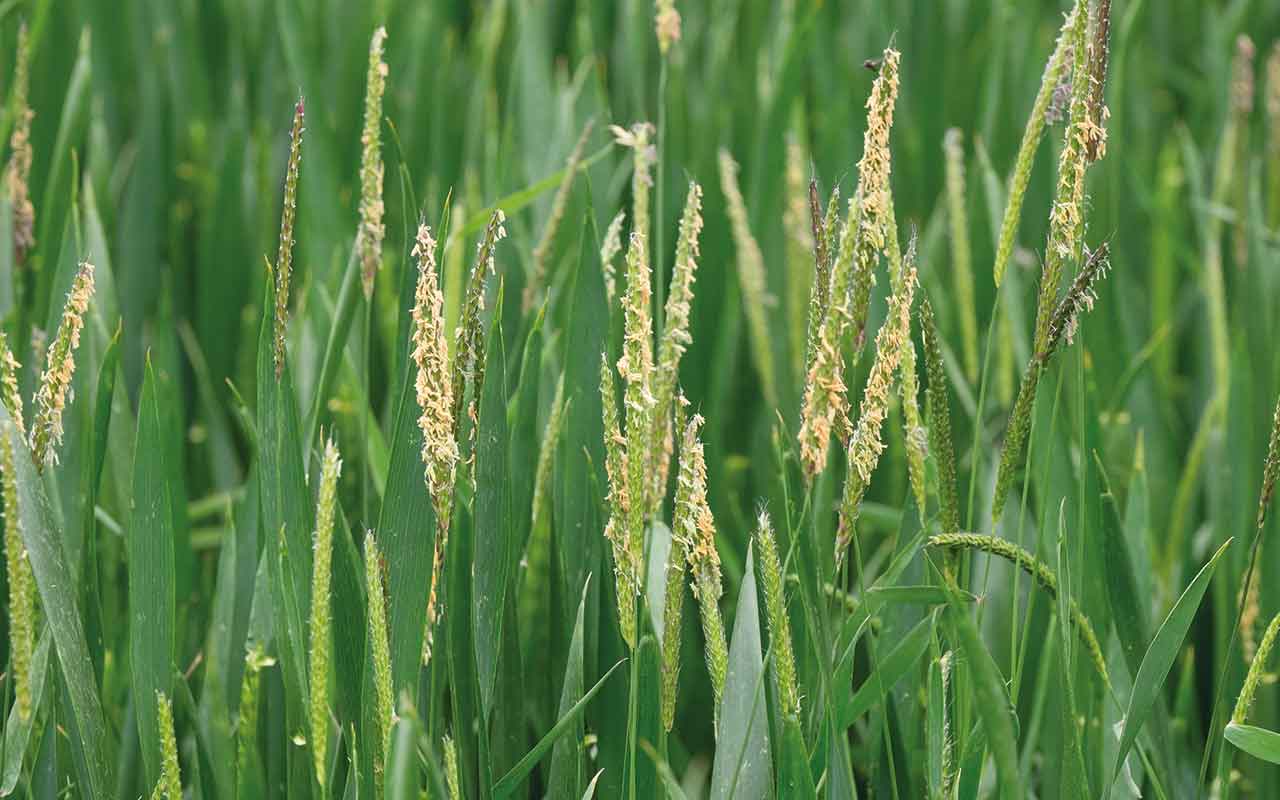
The changing climate is likely to affect pre-emergence herbicide efficacy © Adobe Stock
Boosting efficacy
Oliver Johnson, Nichino commercial technical manager, said the only certainty is uncertainty, which is why growers should consider how they can boost the efficacy of pre-emergence applications.
“An adjuvant like BackRow Max helps hold the active in the upper soil zone for longer, concentrating the applied dose where it can have the greatest effect against emerging blackgrass and ryegrass.
Just as importantly, it helps keep more of the herbicide away from emerging crop roots, reducing the risk that the crop is checked at establishment.
“Bleaching, thinning and discolouration are all signs that a crop has been affected by herbicide stress. When this happens, energy that should be going into root and tiller formation is instead diverted into recovery and stress remediation.”
Supporting cinmethylin performance
Cinmethylin is one of the strongest pre-emergence ryegrass and blackgrass actives, Oliver said, but it also benefits from an adjuvant. Replicated trials conducted last season showed a clear benefit from adding BackRow Max to Luximo mixes, with improvements seen in both wheat plant counts and blackgrass.
“Cinmethylin’s persistence is more limited than some other residual actives. Because BackRow Max is based on mineral oil technology, rather than vegetable or methylated, it is designed to remain active for up to six weeks, aligning more closely with the residual herbicide molecules it is intended to support,” Oliver said.