

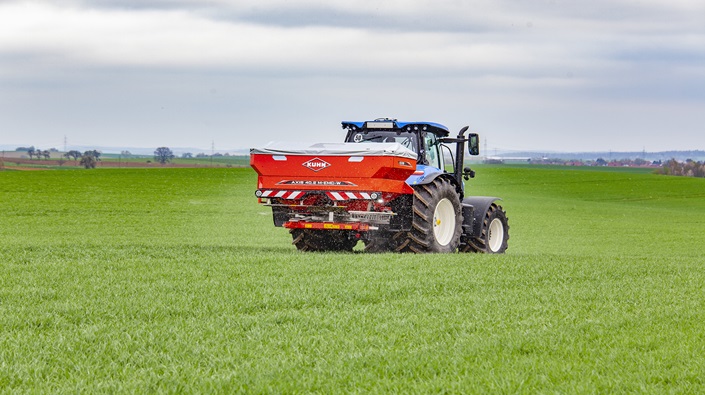
New research from Rothamsted has identified the potential for improved nitrogen management to reduce energy-related carbon emissions from farms across England, but also points to the opportunity for technologies such as green ammonia to contribute more.
The research undertook an assessment of the direct and indirect energy use associated with different types of farms across England, highlighting the important contribution of fertiliser production and application to indirect use.
The study, undertaken as part of the NICCEE (Global Nitrogen Innovation Center for Clean Energy and Environment) Global Centre programme, and published in Food and Energy Security, found that implementing improved nitrogen management practices could reduce energy-related CO2-equivalent impacts by 8.8–13.0%, depending on the type of farm.
The research also found that fertiliser production is a major contributor to farm energy use footprints. For farms without livestock, embedded emissions associated with fertilisers accounted for 39–47% of energy-related impacts.
Reducing the footprint of fertiliser
The researchers modelled current energy use across representative farm types, including cereal, dairy, mixed, general cropping and lowland grazing livestock farms. They then modelled a scenario in which a range of existing best-practice nitrogen management measures were implemented. This scenario reduced the indirect energy use associated with fertilisers by 16–40%.
Dr Y. Zhang, lead author and researcher at Rothamsted Research, said:
“Our findings highlight the importance of looking beyond the fuel used directly on farms when considering agriculture’s energy and carbon footprint. Fertiliser production represents a substantial source of embedded (indirect) energy use, particularly for arable farming.”
The research estimated average annual energy-related CO2-equivalent impacts ranging from 401 kg/ha for lowland grazing livestock farms to 1,002 kg/ha for dairy farms.
Supporting lower-carbon agriculture
The study also simulated that improved nitrogen management could deliver wider environmental benefits, including reductions in eutrophication and acidification impacts.
Professor Adie Collins, science director at Rothamsted Research, said: “Improving nitrogen management is an important opportunity to reduce agriculture’s environmental footprint while maintaining productive farming systems. However, our results point to the opportunity to impact more on the carbon footprints by tackling the embedded or indirect energy use.
“Here, for example, there is potential for green ammonia to make a difference, but the opportunities and risks for such production in the context of the need for consistent renewable energy sources require strategic exploration.
“Understanding the trade-offs and wider benefits of different approaches is essential to developing practical, evidence-based solutions that support more sustainable and resilient agriculture and the systems science applied by Rothamsted Research is ideal for ensuring balanced appraisals of system outcomes.”
The research reported here is currently being extended to explore strategic opportunities for green ammonia production on UK farms, as well as application of life cycle analysis (LCA) of different fertilisers. The work to date already provides evidence that could help inform strategies for reducing agriculture’s environmental footprint while maintaining productive farming systems.