
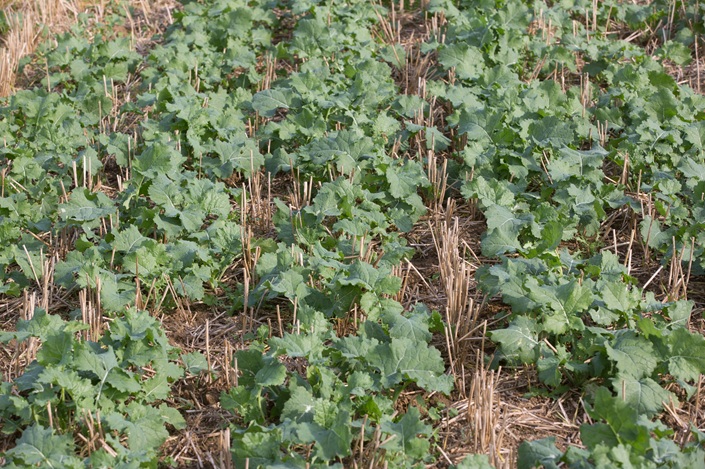
Well-conditioned oilseed rape (OSR) ahead of winter can potentially unlock nitrogen savings in the spring, growers are being advised.
Agrii’s Dr Mark Glover says growers shouldn’t overlook the value of micronutrients to give crops the strongest possible start next spring.
“Growers should be focusing on appropriate micronutrient management this autumn if they want to help build a robust crop which is capable of utilising available nitrogen efficiently,” he says.
That means monitoring crop development through the autumn, using tissue analysis to identify potential deficiencies, and paying particular attention to molybdenum and boron, alongside the major nutrients.
Micronutrients can influence how effectively a crop converts applied nitrogen into biomass and, ultimately, yield. As a result, nutrient decisions made during establishment can have a significant bearing on canopy size in February and the amount of nitrogen required to achieve target yields.
Highlighting the potential spring nitrogen savings associated with a larger canopy, Mark explains: “For a 3.5t/ha OSR crop, a GAI of 0.5 can require around 183kg/hectare of spring nitrogen, compared with about 100kg/ha where GAI is 1.5.”
That represents a difference of more than £100/ha in nitrogen cost (34.5% N @ ~£400/t), with the lower-GAI crop requiring around £249/ha of nitrogen compared with approximately £136/ha for the crop with a GAI of 1.5.
The figures highlight the value of establishing a robust canopy and root structure ahead of spring, rather than trying to bring a weaker crop back later.
“There is nothing worse than getting to February and trying to recover a crop rather than optimise it,” says Mark. “A GAI of 0.5 is okay and manageable, but the cost of getting a 3.5t/ha yield from that is substantial with bagged nitrogen.”
He encourages an integrated approach to nutrition, beginning with soil testing and supported by tissue analysis during the season. “If we don’t measure it, we can’t manage it properly,” he adds.
Critical elements
Molybdenum is a key nutrient that requires particular attention in autumn and spring, especially when trying to optimise use of applied nitrogen in any form, says Mark.
Sulphur is also critical to nitrogen-use efficiency and should not be sacrificed. However, sulphur application has the potential to restrict molybdenum uptake within the plant, even where soil molybdenum levels appear adequate. “That comes back to tissue analysis,” he says.
Low molybdenum can often be easily remedied with a foliar micronutrient application, making it a nutrient worth monitoring as the crop develops.
Boron is another in his view, essential for good root development in OSR, making autumn boron status another key consideration alongside molybdenum.
However, Mark stresses that when it comes to boron, growers should consider the boron formulation when a requirement has been identified.
This is because boron is relatively immobile in OSR, as it produces limited quantities of polyols, compounds involved in the movement of certain nutrients within the plant. Mark says boron formulations associated with polyols improve nutrient mobility because they are transported via the phloem rather than remaining in the xylem.
Agrii trials comparing boron formulations found that conventional boron showed limited movement into younger leaves, while its PolyactivB formulation resulted in significantly more boron detected in younger, developing leaves.
While more applicable in spring and summer, nutrient management also helps OSR cope with environmental stress, including drought and heat. Mark highlights magnesium and potash as particularly important nutrients in this context.
Potassium plays a major role in water and nutrient regulation and plant respiration, while adequate magnesium is important for maintaining photosynthetic activity.
There are concerns over low potassium carryover from last season, he adds, making K availability something growers should monitor, particularly where straw has been removed.