

The ‘Optimising low energy extraction of kelp for soil and livestock nutrition’ project (or Low Energy Kelp), is closer to commercialisation after exceeding its initial targets in controlled field trials.
Funded by Innovate UK, the aim is to optimise low-energy processing of cultivated kelp to create a liquid biostimulant and animal feed supplement.
Algapelago Marine Limited (lead partner), a farming-led seaweed biotech business operating an offshore seaweed farm, collaborated with Rothamsted Research and the UK Agri-Tech Centre to demonstrate the efficacy of these products under abiotic stress conditions.
Interest is growing in the use of seaweed-derived biostimulants as they are derived from a sustainable source with positive environmental impacts. Current agri-seaweed products are dominated by seaweed sourced from wild harvest and the demand for seaweed-derived soil and animal supplements is expected to grow exponentially as policy drives a reduction in chemical inputs.
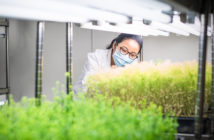
Experiments were conducted at Rothamsted’s controlled environment facilities where the partners could establish optimal application methods and rates for Algapelago’s prototype biostimulant.
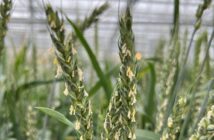
Firstly, Rothamsted investigated the impact of four different rates of foliar applications on wheat and field bean yields under both well-watered and drought-stressed conditions, and secondly, whether foliar application or soil application had the greatest impact on yields of wheat.
Further experiments assessed the timings of applications relative to growth stage, and applications under different drought stress scenarios (only one was tested here), were recommended to further understand and optimise the use of Algapelago’s biostimulant products.
Experiments using different rates of fertiliser application were recommended, as the biostimulant potentially could perform better under more nutrient-limited conditions than those that were used in the study. Evidence found that seaweed-derived biostimulants can—and do— under certain conditions, provide crop yield benefits.
Dr Marieme Drame of Rothamsted Research, North Wyke said: “Kelp-derived biostimulants offer a systems-based solution that works with plant and soil biology to enhance crop performance.
“At the optimal application rate in our wheat trials, we observed improved growth and yield, along with positive indirect effects on soil microbial activity, demonstrating clear value for productive and resilient farming systems.”
Luke Ansell, head of operations & research at Algapelago, said: “The Low Energy Kelp project set out an ambitious goal to unlock the supply of cultivated kelp as a quality agricultural supplement. Over the last two years, we’ve made great progress towards that goal, moving from concept phase to a low-energy processing method stress-tested at a 1-tonne scale.
“The prototype biostimulant product has far exceeded expectations in wheat trials, demonstrating that biostimulants sourced from cultivated seaweed can outperform market incumbents.”