
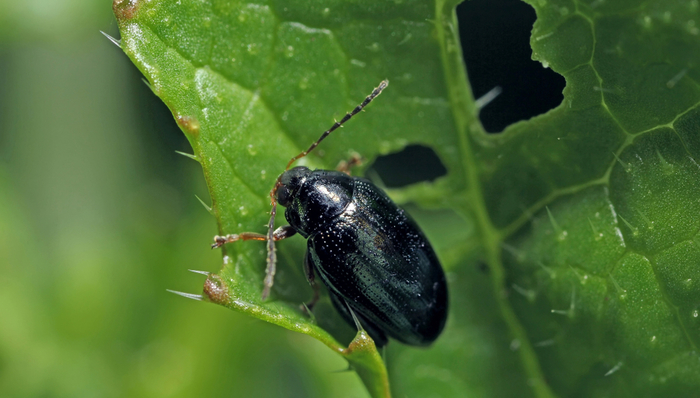
Further trials have highlighted the value of silicon in reducing cabbage stem flea beetle (CSFB) damage.
Undertaken by ProCam on behalf of Orion Future Technologies, it showed that strengthening oilseed rape (OSR) crops can reduce interest in CSFB feeding, resulting in lower larval counts and infestation scores.
The 2025 trial used Deneb, a biostimulant with 4% silicon (SiO₂), and natural plant extracts, which exhibit a strong scent profile.
“The infestation score fell from 4.5 in the untreated crop to 3.3 with two applications of Deneb at 0.5 L/ha — a reduction of approximately 27%. At 0.25 l/ha the score was 3.8, representing a reduction of approximately 16% against the untreated,” says Orion FT agronomist Mike Stoker.
He suggests that similar reductions were seen in larval counts, which reduced from 6 in an untreated crop to 5 with the 0.5 l/ha application.
The trial also showed yield increases and an improvement of stem width by using two applications of Deneb at a rate of 0.5 l/ha and 0.25 l/ha.
“Silicon helps to improve a plant’s natural defences and one of the main takeaways from this trial was stem width, which saw up to a 0.3mm increase compared to the control. While this seems like a very small gain, it is an important reference point for the overall development and establishment of the plant,” he says.
He points to other benefits that silicon biostimulants provide, including helping plants to develop deeper seeking, stronger root structures that help build resilience during and after establishment.
“Gains made during establishment ultimately help to improve yield and, in this trial, the 0.5 l/ha application crop showed a 7.1% increase in yield compared to the untreated crop. This produced 4.9 t/ha, an increase of 0.3 t/ha, equivalent to approximately 7.8% over the untreated crop,” he says.
He concedes that, while the results are encouraging, Deneb and other biostimulants should not be viewed as a solution for insecticidal control. Instead, he sees the benefits of applying such products as an enhancement of any chosen integrated pest management (IPM) strategy.
“Deneb should be considered in the context of an integrated OSR establishment strategy rather than as a replacement for CSFB control. However, this trial has shown that helping to build plant resilience during establishment by using biostimulants could be a valuable option for agronomists looking to help growers increase OSR yield.”