
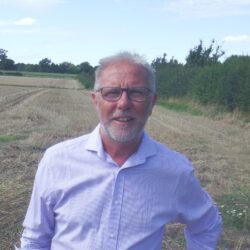
Doing the right things for the right reasons sums up the Tyler family’s approach. Nick and Lucy Tyler run an 850ha mixed farm in north Wiltshire, within the North Wessex Downs National Landscape.
As a Linking Environment And Farming (LEAF) demonstration farm, they are committed to sharing knowledge and showcasing more sustainable farming practices so others can learn from both their successes and challenges.
Like many farmers, they are experiencing first-hand the effects of climate change and believe that both climate mitigation and adaptation are crucial if their business is to remain productive and resilient in the future.
With the support of LEAF and Corteva’s Resilient and Ready programme, they have embraced agroforestry in a big way.
When we spoke to them, more than 39,000 hedge plants and over 500 trees had just arrived to complete a two-year agroforestry project funded by the Great Western Community Forest.
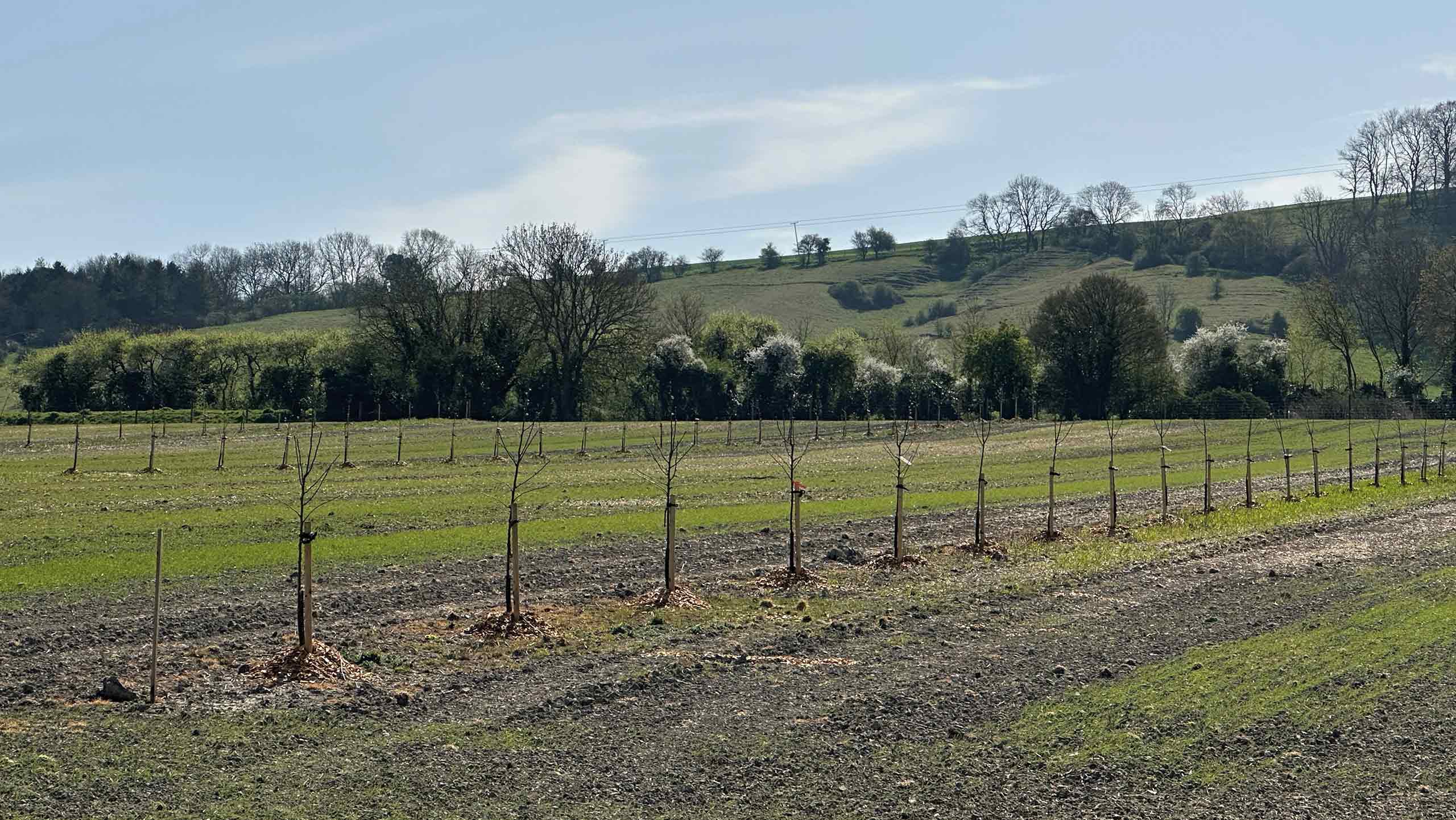
Designed not only to benefit their own business, but also to demonstrate what is possible for others, the project showcases a range of agroforestry systems.
It spans multiple fields and includes silvopasture and silvoarable alleys, traditional orchards, roundels, a woodland area, parkland trees and 10km of new hedgerow.
The Tylers hope the project will encourage other farmers to explore how trees can be successfully integrated into productive farming systems.
No time like the present
The Tylers see agroforestry as an essential future-proofing strategy. “With rising temperatures, we need to enhance shading to ensure our animals can continue to graze, and we cannot do that without trees,” explains Lucy.
“If we don’t start now, the trees won’t be mature enough to provide the shade when it’s required.”
However, the benefits of shade extend beyond livestock. The Tylers also want to protect their arable crops. If climate projections prove accurate, periods of intense heat and drought are likely to become increasingly common.
Following a recent UK Centre for Ecology and Hydrology meeting held on the farm, where the potential effects of global warming on wheat yields was discussed, the couple became even more convinced that action cannot be delayed. “We can’t afford to wait,” says Nick.
But the trees are being planted for far more than shade alone.
“Agroforestry offers multiple benefits, including habitats and wildlife corridors, floral resources for pollinators and natural predators, enhanced soil health, improved water management, environmental enrichment, natural anthelmintic properties for livestock, as well as an additional crop,” says Lucy.
Interestingly, carbon sequestration is not the primary driver behind the Tylers’ decision to plant trees. “We can’t rely on carbon sequestration alone to reach net zero,” says Nick. “We need to do everything we can to reduce emissions.”
The Tylers have already taken significant steps to reduce the farm’s carbon footprint.
These include installing Lely Astronaut milking robots to maximise efficiency and productivity, as well as reduce energy and water requirements; producing most of the starch required in post-weaning rations on farm; reducing reliance on artificial fertilisers by incorporating legumes into crop rotations; and making the most of organic farmyard manure and slurry.
Signs of success
Although it is still too early to measure the full effects of the agroforestry project, the Tylers are closely monitoring biodiversity, soil health and productivity.
Encouragingly, Nick says they have already noticed an abundance of wildlife using the silvopasture and silvoarable alleys.
Naturally, there are still questions to answer. One of the biggest is how much moisture the trees will draw from the surrounding soils. Introducing lines of trees into arable fields at a time when drought is expected to become more common may seem counterintuitive.
However, work by Forestry Research, the research agency of the Forestry Commission, has shown that groundwater recharge rates can, in some situations, be higher under trees than under grassland.
The outcome depends on several factors, particularly tree species and soil type, but in general tree roots draw most of their water from depths of 30–60cm.
There is also the question of how far the soil health benefits generated by the trees’ diverse root systems extend into neighbouring cropped areas.
At present, the Tylers cannot be certain, but ongoing monitoring and testing should help answer these important questions.
While there are still questions about how agroforestry systems perform under UK conditions, particularly around water use and the extent of soil health benefits, the Tylers believe waiting for every answer is not an option.
By monitoring biodiversity, soil health and productivity over time, they hope not only to future-proof their own business, but also to provide practical evidence that helps other farmers make informed decisions.
As Lucy says: “We don’t claim to have all the answers, but if we can demonstrate what works – and what doesn’t – we can help others take the first step.”