
UK start-up RNA AgriBio is looking to develop a potential RNA-based bio-insecticide.
Former agronomist and founder Trevor Grigg has always been interested in science, so he returned to university to study crop protection, where he came across RNA interference (RNAi). During his PhD studies, he found various papers on how RNAi benefits humans, but less on farming, which got him thinking.
Sereene Ghariani explains that RNAi isn’t genetic modification, but temporary gene silencing. By introducing foreign RNA, it gets internalised in cells. The cell takes the RNA sequence, which then breaks down messenger RNA molecules (mRNA) used to make a particular protein; one that is essential for the pest’s survival, such as a species-specific protein involved in pheromone synthesis or feeding behaviour.
It’s a reverse of Covid vaccine technology, says Trevor. “Covid vaccines gave people the RNA code to build the spike protein that primed the immune system. RNAi does the opposite – it turns off the manufacture of a specific protein by the cells.”
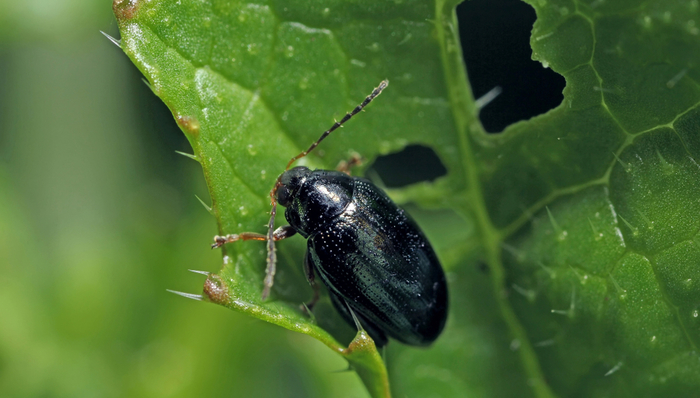
RNA AgriBio came into being after Defra put out a farming feasibility call for the sustainable control of ‘pressing problems’. Initial lab testing proved promising and further testing has shown up to 45% mortality of cabbage stem flea beetle (CSFB) adults 31 days after application and 70% mortality of CSFB larvae in four days. As a result, Defra has provided further funding to extend the research.
The company is now relocating to the Norwich Science Park to be nearer its partner, the John Innes Centre. It is also seeking to expand its team and attract investment, as well as obtaining an administrative trials permit from the Chemical Regulations Division so it can undertake field trials. If everything goes to plan, a product could be on the market by 2030. Whether this is something that acts as a bio-insecticide, killing beetles and larvae, or something that deters them from feeding remains to be seen. Keeping these pest beetles alive might benefit beneficial insects such as parasitic wasps and ground beetles that prey on CSFB populations.
For those who question the feasibility of RNA technology, or feel uneasy about the science, it is increasingly being used by US farmers to tackle colorado potato beetle (CPB).
Developed by Greenlight Biosciences, Calantha is a foliar RNA insecticide that provides effective control of CPB in potato crops. Its active ingredient, ledprona, not only brings a new mode of action, but being a natural polymer, it also breaks down on the leaf surface within days, leaving no crop residues.
Because it is specific to CPB, there is no harm to beneficials or the environment. The company has also just launched RNAi technology for the control of the varroa mite, which has had such an effect on bee populations.
The beauty of RNAi technology is that it is highly customisable, says Sereene. “Our technology is based on the same mode of action as ledprona and we expect it can be adapted to other problems.
It appears successful on pollen beetle too. It isn’t such a problem here, but is in Europe.” Lab testing has also proved promising to fight the fungus rice blast. “There is no reason why it cannot work on pathogens like septoria or rusts,” says Trevor. But just how complex RNAi research is can be seen by the technology’s results when used on fruit flies. It has proved less successful, as fruit flies appear to be less systemic than other insect species. “They internalise RNA, but it doesn’t get transmitted to other cells,” says Sereene